5 Stages in Design Thinking
SANTI WIDIASTUTI S.T, M.T
14 November 2022
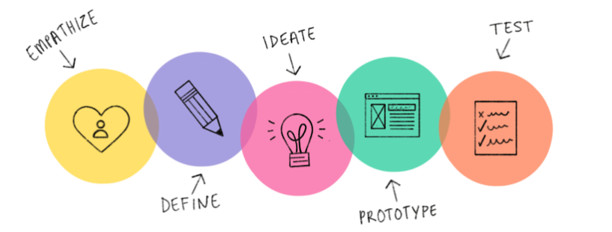
As previously explained, the design thinking methodology has 5 stages: Empathize ,
Define , Ideate , Prototype , and Test . The five stages are carried out
iteratively and linearly. That is, these stages do not have to be done
sequentially; researchers can return to
the previous stage to dig up more data.
1. Empathize
At the empathize stage , the researcher collects high-quality data to understand
the user . At this stage, you must
understand the user 's needs,
constraints, behavior, and aspirations . For that, you have to empathize with
the user , observe and interact without
having assumptions that can block your point of view.
2. Define
Based on the data that you have
obtained from the empathize stage , you
can begin to define the insights and patterns that emerge. What are the main
problems faced by users ? What obstacles
were found? What are their hopes?
3. Idea
fter understanding and clearly
defining the user and
problem , you can now think of a
suitable solution in the ideate stage .
At this stage, you can create mind-maps and wireframes to think about the
solutions you offer to existing problems.
4. Prototype
Well, at this stage you will turn
your ideas into reality! The prototype
that is made does not have to be perfect, because it will be tested in the following stages and will be improved
iteratively continuously.
5. Test
After creating a prototype , you must check whether the
solution you provide really answers the
user 's needs . At this stage, you can do various types of testing
to get real feedback from
users . Make sure at the end of this stage, you understand correctly
whether there are aspects that can be improved again and then re-developed.
Tentang Penulis
SANTI WIDIASTUTI S.T, M.T
Penulis — Universitas STEKOM
Penulis aktif yang berfokus pada isu-isu akademik, teknologi pendidikan, dan pengembangan sumber daya manusia di lingkungan kampus.